
Why are percussion drums rarely harmonic?
Fundamental Question
What’s common between wind instruments like flute and string instruments like guitar? Importantly, how are percussion instruments different in that aspect from both the wind and string instruments?
Frequencies and Music
Frequencies of sound are an important aspect of music composition and production. If you have ever attempted to learn an instrument you’d know how some frequencies relate to another frequency. Such relationships form basis of system of octaves (in Western classical music) or स्वर (in Indian classical music). Another important relationship is of ‘harmonics’. When some set of frequencies produced by an instrument are integer multiple of other frequency, they are said to be in harmonic relationship.
Wind, String, and Percussion
Here’s the thing. Most wind and string instruments produce sound which are harmonics. Meaning, if you struck various strings of a guitar you’ll get set of frequencies wherein some of them are integer multiple of the others. The lowest frequency in such a set is called a fundamental frequency. While both wind and string instruments are alike in this, the percussion instruments are characteristically not. The frequency ratios generated from percussion drums are rarely harmonic, in fact, suprisingly they are irrational numbers. But why? To see that we need to dive into some mathematics of how vibrations work.
Some Math
The noise generated by each of these instruments is due to vibration of some medium. Such vibrations are governed by Wave equation. One (of the many) way of obtaining the solution of this equation is to tranform it to frequency domain which leads to Helmholtz equation. When you do this - out pops an eigenvalue problem. Eigenvalue problems are ubiquitious in physics and for those who don’t know much about them or have never heard about them, know for now, that they contain the fundamental shapes of vibration and also the frequencies. All vibrations are linear combination of these fundamental shapes (or modes).
Answer to the question
Back to our problem. It turns out that the eigenvalue problem arising from strings and air columns usually leads to zeroes of a trigonometric function and hence results in harmonic series. On the other hand, for membranes of percussion drums, the eigenvalue problem boils down to zeroes of Bessel functions whose roots are irrational numbers, thus making the frequency rations irrational too.
But are there exceptions?
Yes there are. It seems that humans love to hear music that contains harmonic notes. We’ve over a period of our civilization and across classical musical traditions modified the designs of drums to work around the irrational ratios. Notable examples are two drums from the family of Indian classical musical insutrments: Mridangam and Tabla. Both of these instruments are incredibly popular in the southern and northern muscial family traditions in India. The modifications made to design are simple as changing the mass distrbution of the membrane or utilizing the air backed cavity or even the structure over which the membrane is stretched.
Zooming in on Mridangam
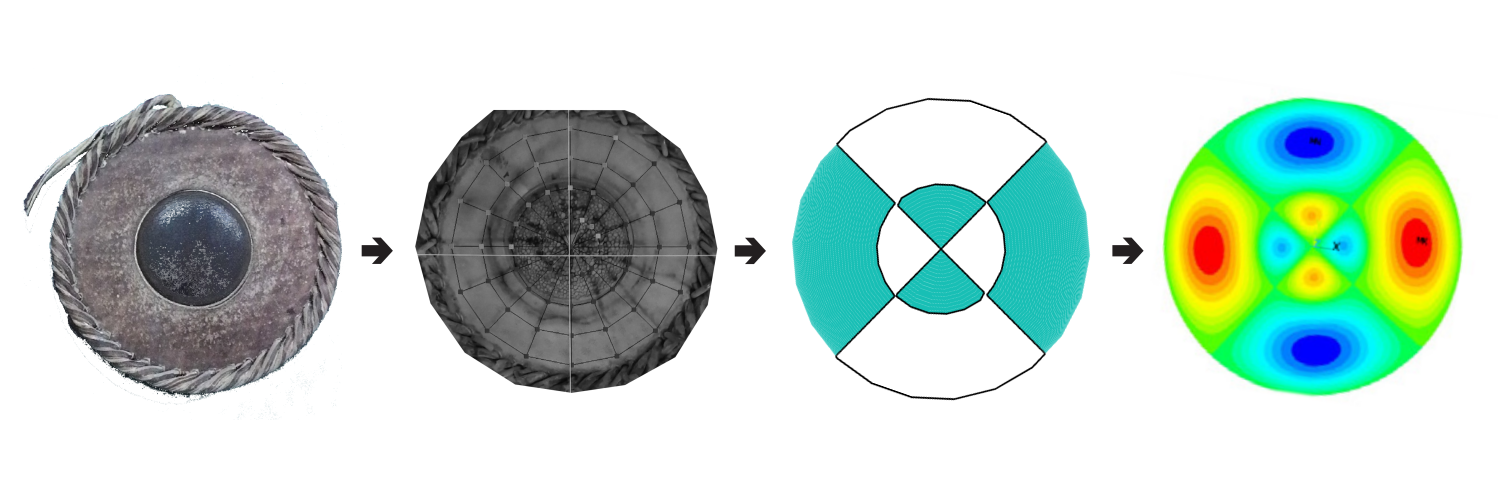
The spotlight of this article is Mridangam. In a recent study, we created a mathematical model of the membrane of the Mridangam. This model was constructed based on the three individual layers that form the composite membrane. We performed material and mechanical testing of the material to ascertain their stiffness as well as densities. Finally we solve the previously mentioned Helmholtz equation for the membrane through (i) pseudospectral method, and (ii) finite element method. Finally, we also conducted experiments using laser vibrometery to extract the mode shapes experimentally and compare them to two numerical models we had.
Read the complete study: https://doi.org/10.1016/j.apacoust.2021.108121